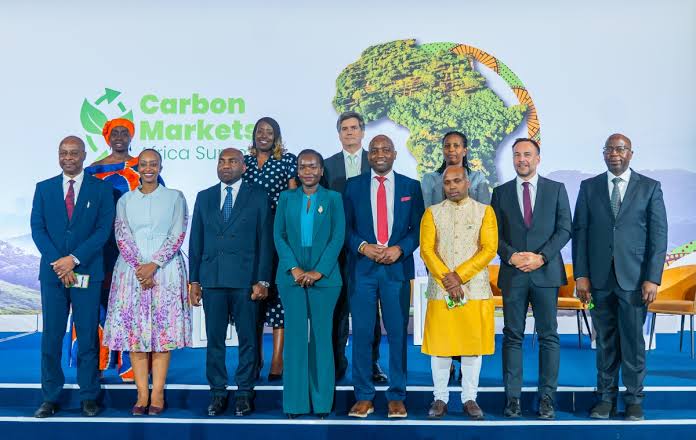
The Carbon Markets Africa Summit (CMAS) 2026 opened in Kigali, Rwanda, bringing together policymakers, investors and project developers from 45 countries, including 21 African states, to shift the dialogue from market readiness to actual delivery of carbon projects.
Rwanda’s Environment Minister Dr Bernadette Arakwiye stressed that Africa’s carbon markets must be shaped by African priorities and deliver tangible benefits, noting progress in frameworks, authorisations and bilateral agreements while warning that finance remains concentrated in a narrow set of project types.
Arakwiye called for diversification into renewable energy, electric mobility, sustainable waste management, industrial decarbonisation, agriculture and landscape‑scale nature‑based solutions, and identified three scaling priorities: African‑appropriate methodologies, project‑readiness finance and long‑term fair‑value demand.
UNDP’s Maxwell Gomera highlighted the importance of market infrastructure that channels value from buyers to farmers, backed by strong community rights, enforceable benefit‑sharing and early‑stage finance.
UNFCCC markets manager Perumal Arumugam warned that Africa should compete on the credibility of its tonnes rather than price, stressing that success will be measured by investment mobilisation, mitigation outcomes and community benefits.
Representing AUDA‑NEPAD, Esterine Fotabong called for predictable authorisations, functional registries and robust MRV systems, as well as capacity‑building in validation and verification to expand carbon finance into agriculture.
The European Commission’s Lukas Visek signalled forthcoming EU demand for international credits, insisting that additionality and permanence are non‑negotiable and that quality will be rewarded in future markets.
Development finance institutions highlighted practical barriers to investment: policy certainty, early‑stage preparation, bankable pipelines, strong governance and risk‑sharing mechanisms are needed to unlock capital for African projects.
African Development Bank director Anthony Nyong framed carbon projects as development projects, while DBSA’s chief investment officer Greg Fyfe stressed the catalytic role of patient capital and risk absorption by development banks.
The summit’s opening sessions concluded that the continent must transition from fragmented pipelines to investable assets, linking credible projects with buyers and capital to ensure Africa shapes the next generation of global carbon markets.



Comments