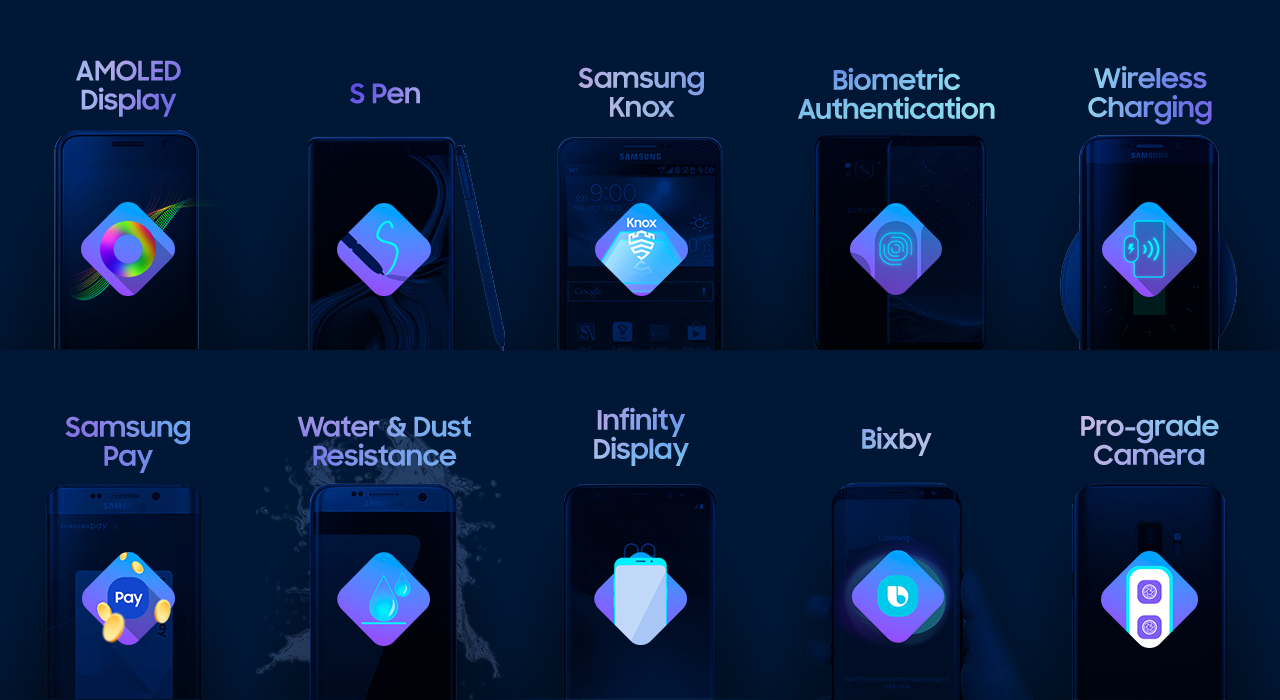
Samsung launched the Galaxy S in 2010 with a Super AMOLED display, the company’s first smartphone to integrate touch sensor and screen in a single layer, delivering thinner devices with vivid colour and strong contrast.
The 2011 Galaxy Note introduced a large‑screen phone paired with the S Pen stylus, creating a hybrid device that functioned as a digital notebook and helped define a new category between smartphones and tablets.
In 2013 Samsung unveiled Knox, a security platform that isolates work data from personal information on the same device, marking an early move to embed enterprise‑grade protection in consumer smartphones.
The Galaxy S8, released in 2017, featured Bixby, Samsung’s voice‑assistant aimed at more conversational and context‑aware interaction, signalling the brand’s entry into on‑device artificial intelligence.
Beyond phones, Samsung introduced the world’s first Curved UHD TV in 2013 and, five years later, the modular 146‑inch MicroLED The Wall, both intended to transform the viewing experience through new form factors.
In 1995 the company rolled out Twin Cooling for refrigerators, separating cooling circuits for fridge and freezer compartments to maintain distinct temperature and humidity levels and reduce odour transfer.
Samsung’s Eco Bubble technology, introduced for washing machines, mixes air, water and detergent into bubbles that penetrate fabrics quickly, enabling effective cleaning at lower temperatures and lower energy use.
The 2019 Galaxy Fold debuted a 7.3‑inch Infinity Flex Display that unfolded to a tablet‑size screen, challenging the assumption that smartphone displays must remain fixed and spawning the later Z Fold and Z Flip families.
Samsung’s 2024 Galaxy S24 series integrated Galaxy AI features such as Circle to Search, Live Translate and Chat Assist, embedding artificial intelligence directly into everyday smartphone tasks like searching, communicating and creating content.


Comments