
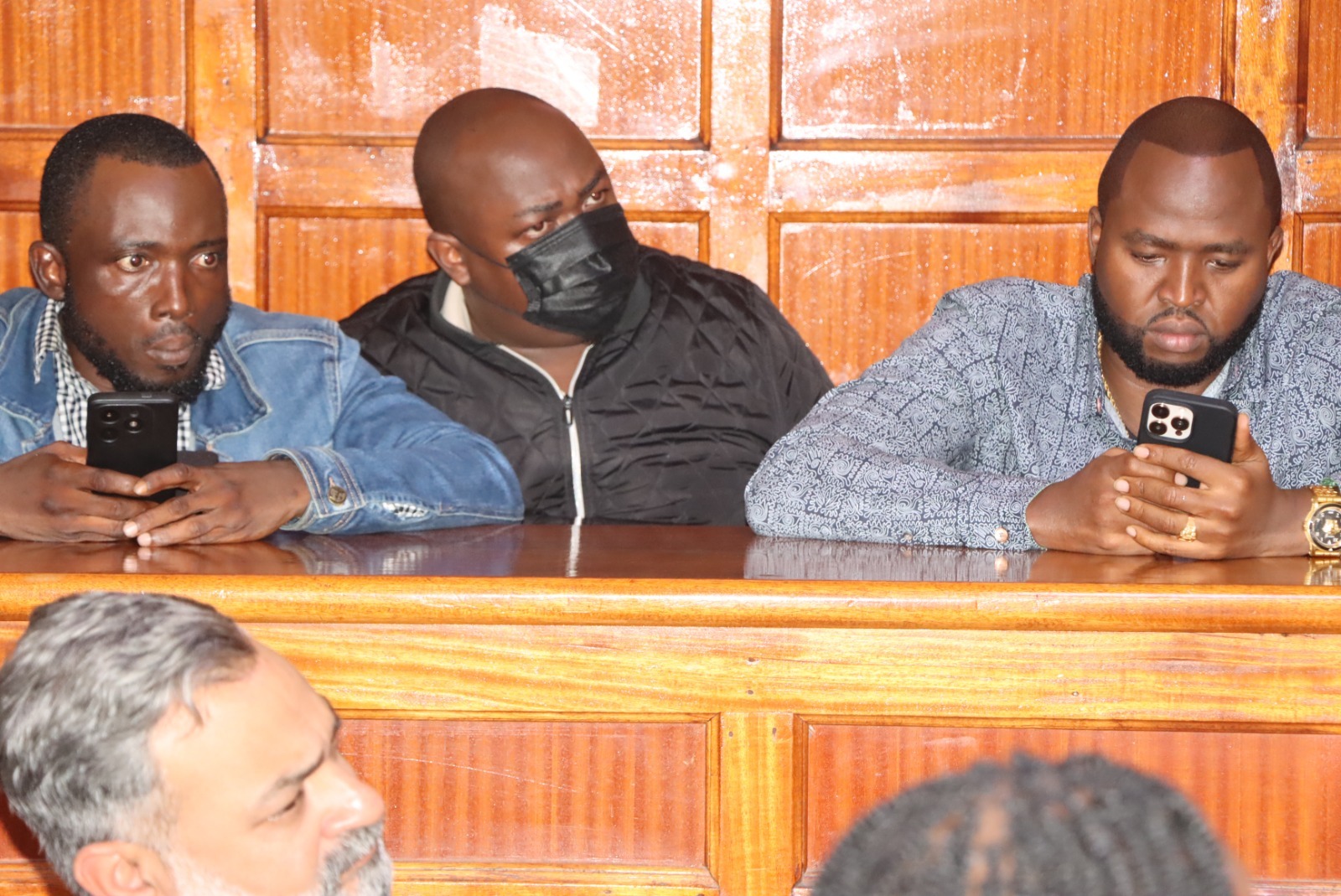
A Kenyan journalist has raised alarm over a series of disturbing messages he says were sent in connection with businessman Joseph Lendrix Waswa, amid an escalating dispute over an online article that Waswa apparently wanted removed from the internet.
Screenshots reviewed for this story show messages containing language that the journalist interpreted as threats to his life after he declined to take responsibility for an article published by another website and refused to guarantee that it would be deleted.
The dispute centres on an article published by The Kenyan Daily Post concerning Waswa’s private life and an alleged confrontation involving his wife at offices associated with Magnum Credit. The article carried the provocative headline: “Magnum Credit boss Joseph Waswa flies wife to a lavish vacation in Paris to cool things off after she stormed office and fought senior female staff member over their affair.”
The claims in that article concerning Waswa’s marriage and an alleged affair are not the subject of this article. What is significant in the latest controversy is that the journalist being pressured over the publication says he neither owns nor controls the website that published it.
Despite explaining that distinction and attempting to withdraw from the matter entirely, the screenshots show that the dispute escalated into language that the journalist says left him fearing for his safety.
“I Have Stayed Too Long Without Seeing Someone’s Blood”
Among the most disturbing exchanges is a message sent during a WhatsApp conversation in which the sender writes in a mixture of Dholuo, Kiswahili and English:
“Omera abomanyi ngane nimekaa sana bila kuona Damu ya mtu.”
The unmistakably disturbing part of the message is: “nimekaa sana bila kuona Damu ya mtu” — literally, “I have stayed a long time without seeing someone’s blood.”
The journalist subsequently attempted to remove himself completely from the dispute, writing:
“Am out of this business. Thanks for your time.”
The response was chilling:
“You can’t be out.”
The journalist then replied:
“I dont want blood in my hands.”
Instead of allowing him to disengage, the response insisted that he should speak to the person behind the publication.
Read together, the exchanges raise serious questions about why a disagreement over an online article should descend into references to blood and insistence that a journalist cannot simply walk away from a dispute involving a website he says he does not own.
For a journalist, those are not words that can simply be brushed aside as ordinary disagreement.
Second Message Warns: “Wait You Will See What I Will Do”
The WhatsApp messages were not the only communications provided.
A separate SMS exchange shows another confrontation in which the incoming sender writes:
“Bro nitakupeleka mbio na Hio storie. Hutapenda.”
Loosely translated, the message warns: “Bro, I will deal with you over that story. You won’t like it.”
During the increasingly hostile exchange, another incoming message states:
“Wait you will see what I will do.”
Taken individually, someone might attempt to dismiss such sentences as anger, bravado or words exchanged during a heated argument. When considered alongside the earlier reference to having gone a long time without “seeing someone’s blood,” however, the journalist says the communications became sufficiently disturbing for him to preserve the screenshots and document what had happened.
The journalist says he regarded the messages as threats and became concerned that a disagreement about an online publication was developing into something potentially dangerous.
The Journalist Doesn’t Even Own the Website
Perhaps the most extraordinary aspect of the entire dispute is that the journalist being pressured says the controversial article isn’t even published on his website.
The screenshots show him repeatedly attempting to explain that, as a journalist and communications professional, he communicates with big bloggers and other media personalities as part of his work but does not control their publications.
At one point, he explains that he talks to different bloggers because he is also in the media industry and sometimes deals with them professionally. He further makes clear that this does not mean he owns their websites or has authority over what they publish.
That distinction should not be difficult to understand.
Journalists, bloggers, editors and public relations professionals routinely communicate with one another. Knowing a publisher does not make somebody the owner of that publisher’s website. Speaking to a blogger does not provide administrative access to their publication, and being able to contact an editor does not mean someone can order that editor to delete a story.
If Waswa believes a publication has defamed him, Kenya provides lawful avenues through which he can seek a correction, right of reply, retraction or legal remedy. Pressuring a journalist who says he does not control the publication solves none of those issues.
The Story Was Published Somewhere Else
The distinction is especially important because the article at the centre of the dispute was published by The Kenyan Daily Post, not by the journalist now raising concerns about threats.
The journalist says he neither owns nor operates that publication.
The article concerns an alleged confrontation involving Waswa’s wife and a female employee associated with Magnum Credit, followed by claims that Waswa later travelled with his wife to Paris.
Those claims belong to the publisher that made them. If Waswa believes they are false, malicious or defamatory, his dispute should logically be with the publisher and should be pursued through appropriate legal or media channels.
What becomes troubling is an attempt to make another journalist personally responsible for securing the removal of content from an independent publication.
A journalist cannot delete what he does not control.
And he should certainly not fear violence because he cannot persuade somebody else to remove a story.
Waswa’s Name Is No Stranger to Controversy
The latest episode is particularly concerning because Joseph Lendrix Waswa isn’t an unknown individual suddenly thrust into public scrutiny.
His name has appeared repeatedly in Kenyan court records and news reports concerning serious criminal cases and investigations over the years. That history must be reported accurately because being charged, investigated or named in a case is not the same thing as being convicted.

In September 2023, People Daily reported that Waswa had been ordered to appear before court in connection with investigations arising from a purported KSh1 billion fake-gold transaction. The publication reported that he was expected to answer a charge concerning possession of forged US banknotes valued at approximately KSh93.7 million. People Daily report
The Star similarly reported in October 2023 that several suspects had been charged following investigations into a fake-gold deal involving a Tunisian businessman and said Waswa was expected in court separately concerning alleged forged banknotes. The Star report
Subsequent developments are equally important. In August 2025, prosecutors reportedly applied to withdraw charges against Waswa in a KSh400 million gold-fraud case after reviewing the file. Reporting on those proceedings said prosecutors informed the court that the alleged offence involving Waswa had not materialised and that they no longer wished to continue the case against him.
That development matters because previous accusations involving Waswa should not be distorted into convictions where none exist.
The KSh1 Billion Gold Case Wasn’t His Only Brush With Headlines
Waswa’s name had entered national headlines years earlier.
In 2019, police seized approximately KSh32.6 billion in counterfeit foreign and local currencies together with what investigators described as suspected fake gold from a residence in Ruiru.
Business Daily reported at the time that police linked the discovery to investigations into a group suspected of impersonating then-President Uhuru Kenyatta in an attempt to obtain money from businessman Naushad Merali. Waswa was among the suspects identified in reporting surrounding the investigation. Business Daily report
Waswa subsequently complained publicly about aspects of media coverage surrounding him, particularly reporting that brought his wife and private life into stories concerning the controversy.
That history makes the latest confrontation over another article concerning his private life especially striking.
There is nothing improper about Waswa objecting to reporting he considers inaccurate, intrusive or defamatory. He has every right to challenge journalists, demand corrections, issue a statement, instruct lawyers or seek redress through the courts.
What no public figure is entitled to do is threaten violence against a journalist.
Whether the latest communications meet the legal threshold for criminal threats is ultimately a matter for investigators and, if the matter reaches prosecution, the courts. But the language shown in the screenshots is serious enough to warrant scrutiny.
Waswa Is Currently Facing Another Fraud Case
The businessman has also been connected to another criminal proceeding.
In July 2026, The Star reported that Waswa and former Sports Cabinet Secretary Rashid Echesa were among defendants in a KSh250 million fraud and extortion case involving Kakamega Governor Fernandes Barasa.
According to the report, a Kibera court gave Barasa a final opportunity to supply financial records requested by the defence so that the long-running trial could proceed. The charges remain accusations to be determined by the court. The Star report on the case
The existence of pending criminal proceedings does not establish Waswa’s guilt. He remains entitled to the presumption of innocence and to challenge the prosecution’s evidence.
But his extensive history in court and in the media makes it even more difficult to understand why a dispute over an unwanted article would apparently descend into aggressive private messages instead of being addressed through lawyers, a demand for correction or other established mechanisms.
His Name Has Even Reached Kenya’s Supreme Court
Waswa’s encounters with Kenya’s criminal justice system stretch back further.
Official Kenya Law records show that in Joseph Lendrix Waswa v Republic, Waswa was facing a murder charge arising from the 2013 death of 22-year-old Mitch Barasa Kibiti. He pleaded not guilty, and litigation that subsequently reached Kenya’s appellate courts concerned the extent to which lawyers representing a victim’s family could participate in criminal proceedings. Kenya Law judgment
The appellate litigation concerned important procedural and constitutional questions surrounding victim participation and should not be misrepresented as establishing Waswa’s guilt on the underlying charge.
Nevertheless, it forms part of the extensive public court record involving a businessman whose name has repeatedly appeared in serious litigation and media reporting.
Being a Public Figure Means Facing Scrutiny
One revealing portion of the WhatsApp conversation concerns Waswa’s apparent frustration about his family being discussed publicly.
The journalist tells him:
“You need to change such because you are a public figure.”
The response is:
“It’s my life men.”
That is, of course, partly correct. Public figures retain privacy rights. Being wealthy, politically connected, famous or frequently appearing in the media does not give journalists an unlimited licence to publish false claims about someone’s marriage or family.
But public figures also have lawful options when they believe those boundaries have been crossed.
Waswa can issue a statement rebutting the story. He can request a correction or right of reply. He can send a demand letter. He can lodge a complaint with the appropriate media bodies where applicable. He can institute defamation proceedings if he believes the legal threshold has been met.
What cannot become normal in Kenya is the idea that an unwanted headline should result in journalists receiving messages referring to blood or warning them that they will “see” what somebody will do.
Journalism Cannot Be Conducted Under Threat
The underlying article about Waswa’s wife and an alleged female employee may ultimately be accurate, inaccurate or somewhere in between. That is a separate journalistic issue that should be resolved on evidence.
If Waswa disputes the article, he should identify which assertions he says are false and provide his version of events. The publisher should then assess that response and make any correction that the evidence warrants.
But the situation changes fundamentally when a journalist who says he did not publish the article receives messages he interprets as threats because he cannot make another publisher remove it.
Kenyan journalists already operate in an environment where powerful political and commercial interests frequently attempt to influence reporting. Normalising intimidation as a method of dealing with unfavourable coverage would create an extremely dangerous precedent.
A journalist should never have to choose between helping someone suppress an article and fearing for his life.
And a journalist who does not even control the offending publication should certainly not become collateral damage in someone else’s dispute with a blogger.
Waswa Should Explain the Messages
The most immediate questions for Joseph Lendrix Waswa are therefore not about gold, old court cases, Magnum Credit or even Paris.
They concern the communications now in the journalist’s possession.
What did the sender mean by saying he had stayed a long time without seeing someone’s blood?
What was meant when the journalist attempted to withdraw from the dispute and was told:
“You can’t be out.”
What was meant by:
“Bro nitakupeleka mbio na Hio storie. Hutapenda.”
And what was behind the subsequent warning:
“Wait you will see what I will do.”
Most importantly, why was a journalist who says he neither owns nor controls The Kenyan Daily Post being pressured over an article published by that outlet?
Those are questions Waswa should have an opportunity to answer.
They are also questions that should not disappear merely because the journalist receiving the messages fears what might happen if he speaks publicly.
Kenya’s constitutional protection of media freedom exists precisely because journalism cannot function properly when reporters fear personal retaliation from people displeased by coverage.
Businessmen, politicians and other powerful individuals have every right to defend their reputations. They have every right to challenge inaccurate reporting and pursue publishers through lawful channels.
If a publication lies about you, challenge the lie. If it defames you, seek legal redress. If it gets its facts wrong, demand a correction.
But no journalist should have to receive messages about “seeing someone’s blood” simply because another publisher refuses to delete an article.


Comments
Leave a comment
Your email stays private. Comments appear after moderation.