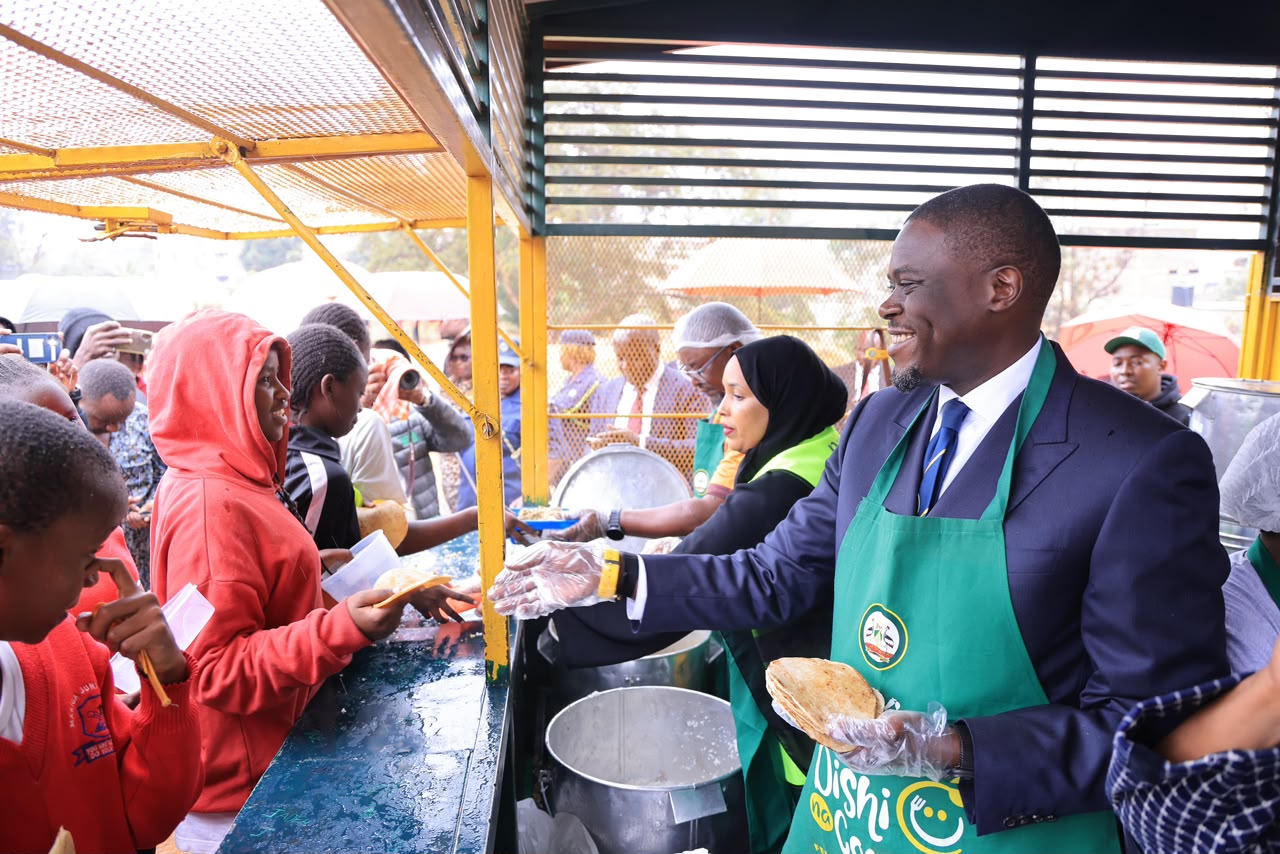
At the Agriculture and Food Security Summit in Jamhuri Park, Governor Sakaja Johnson explained that the Dishi Na County school feeding programme procures and prepares roughly 37 tonnes of food for Nairobi’s public schools every school day.
That volume works out to about 740 tonnes each month, providing a steady outlet for cereals, pulses, vegetables and fruit.
Rice forms the bulk of the menu, with 13.5 tonnes cooked daily, followed by 5.6 tonnes of Mwitemania beans and 4.8 tonnes of cabbages and kales.
Legumes such as yellow beans, cowpeas and ndengu each contribute around 2.8 tonnes per day, rotating through the school meals.
Combined, rice and the various legumes total 27.5 tonnes, representing roughly 74 percent of the programme’s daily food volume.
Fresh vegetables also feature prominently, with daily usage of about 8 tonnes: cabbages and kales account for 4.8 tonnes, tomatoes 1.2 tonnes, carrots 1.1 tonnes and onions 0.9 tonnes.
The scheme also calls for roughly 25,000 pieces of fruit each day, mainly bananas and oranges.
Supplies are sourced from 27 counties; 24 provide vegetables and fruit, nine deliver cereals and pulses, and six supply both categories.
Governor Sakaja noted that the predictable, large‑scale demand enables farmers and cooperatives to plan production, aggregation and delivery around the programme’s needs.
He concluded that the Dishi Na County initiative illustrates how public programmes can deliberately create reliable institutional markets for agricultural producers.


Comments