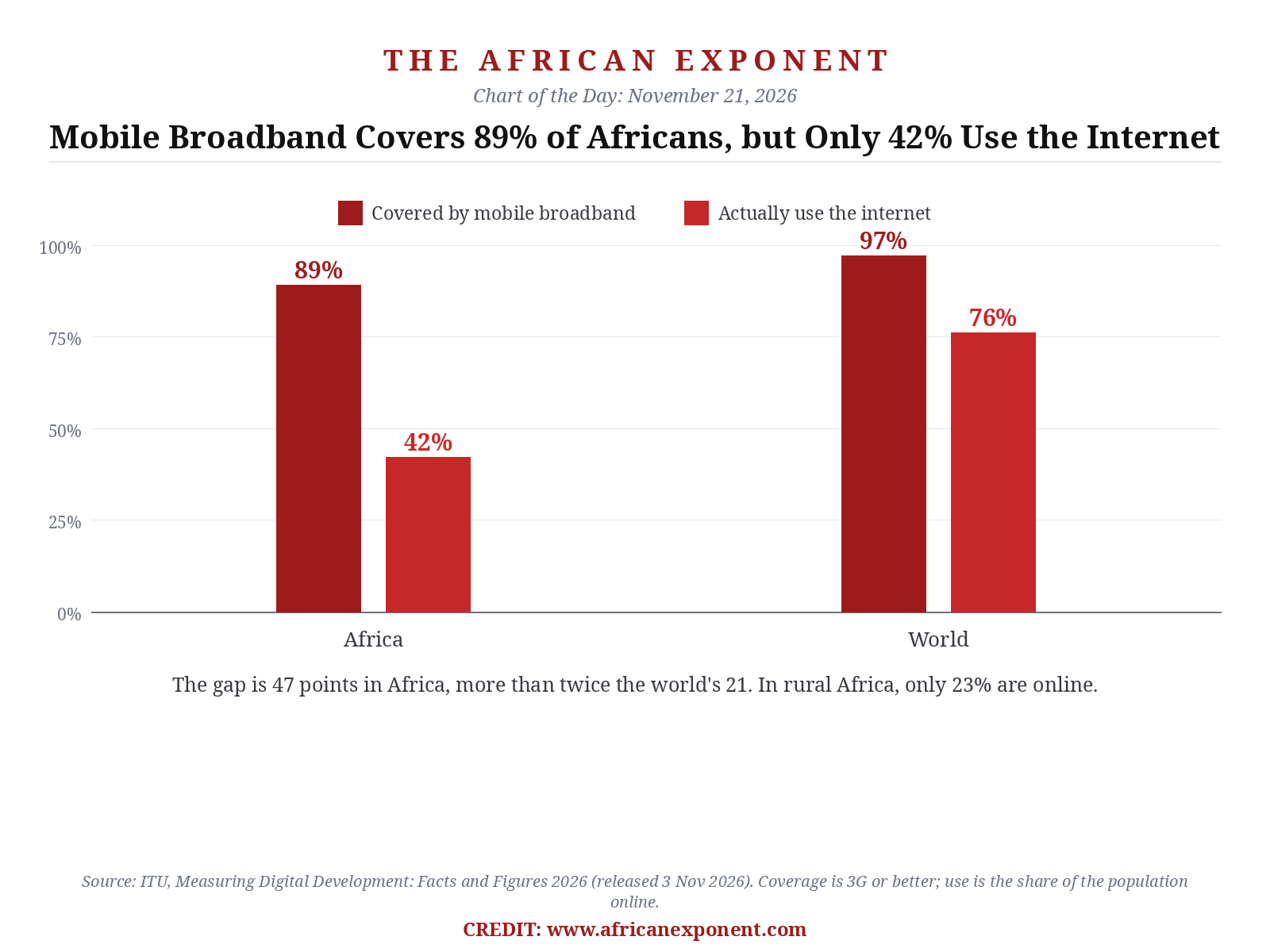
The International Telecommunication Union’s Facts and Figures 2026 indicates mobile broadband signals now reach 89% of Africans, but only 42% of the continent’s residents are online.
This creates a 47‑percentage‑point gap between network availability and actual internet use, the widest disparity of any world region.
By contrast, global mobile broadband coverage stands at 97% with 76% of people using the internet, a gap of 21 points, meaning Africa’s shortfall is more than twice the global average.
The ITU defines coverage as the share of the population within reach of a 3G‑or‑better mobile broadband network, regardless of whether they subscribe.
Use is measured as the proportion of individuals who actually access the internet, according to the same ITU methodology.
Affordability remains a key barrier: a 5 GB data plan costs about 4.5% of average African income, nearly four times the world median and well above the 2% target set by the Broadband Commission.
Device costs also limit uptake; while 68% of Africans aged 10 and above own a mobile phone, only 42% use the internet, indicating that ownership does not translate into connectivity.
Rural areas lag further behind, with just 23% online compared with 52% in cities, and 21% of rural residents lacking any mobile broadband signal.
Gender disparity persists: 38% of women are online versus 45% of men, underscoring uneven digital inclusion across the continent.
The GSMA’s September 2026 roadmap estimates that about 906 million Africans are covered by mobile broadband yet remain offline, with an additional 122 million beyond any network.

Comments