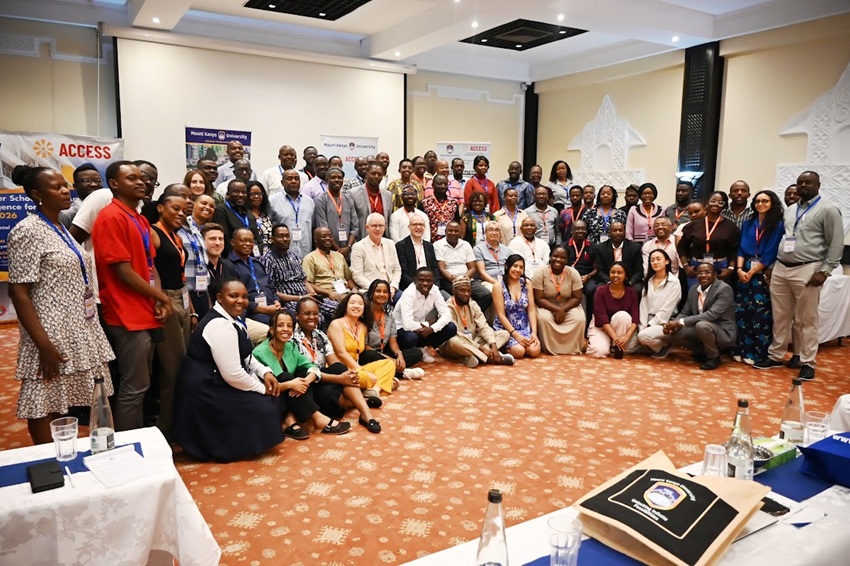
Education stakeholders gathered at the 2026 Annual University Conference and Intelligence for Innovation (IN4IN) in Mombasa to advocate a university model that foregrounds innovation, entrepreneurship, industry collaboration and practical problem‑solving.
Mount Kenya University Pro‑Chancellor Dr Vincent Gaitho led the call, urging institutions to move beyond tallying conferences and boot camps and instead demonstrate tangible outcomes of their innovation and entrepreneurship programmes.
Prof Jaganyi, speaking at the same conference, challenged universities and partners to assess impact by tracking businesses created, jobs generated, young entrepreneurs empowered and communities benefiting from university‑led innovations.
Dr Gaitho stressed that universities must evolve from pure teaching and knowledge dissemination to become hubs of knowledge creation, practical solutions and entrepreneurial activity.
He also highlighted the need for institutional collaboration, noting that no single university can independently tackle the complex societal challenges confronting Kenya.
Prof Dr Utz Dornberger of Leipzig University’s SEPT Competence Center observed that rapid changes driven by AI, digitalisation, climate change and emerging technologies require universities to rethink education, research and innovation approaches.
He argued that graduates need not only qualifications but also critical thinking, creativity, digital skills, problem‑solving abilities and an entrepreneurial mindset to propose practical solutions for employers.
Dornberger outlined a generational shift in universities—from traditional teaching and research to entrepreneurial, ecosystem and digital universities—emphasising industry partnerships, startup creation and AI‑driven open innovation.
He described “living labs” as user‑centred open‑innovation ecosystems that embed research and innovation directly within real‑life communities, bringing together universities, businesses, government and civil society to co‑create solutions.




Comments