
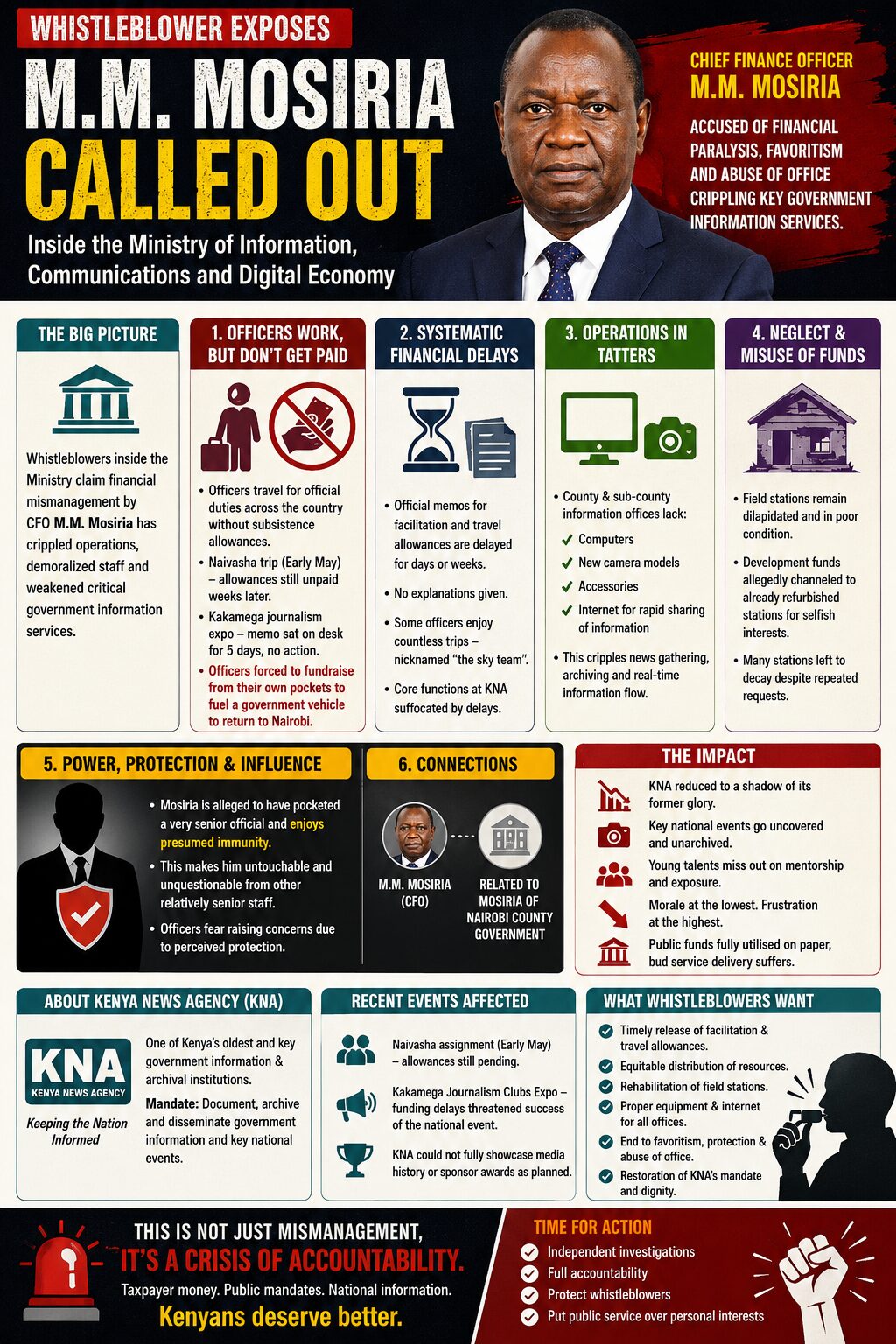
A storm is quietly exploding inside the Ministry of Information, Communications and the Digital Economy, where whistleblowers are now accusing powerful officials of allegedly choking operations, frustrating government communication systems and driving one of Kenya’s oldest state media institutions into collapse through financial paralysis, favoritism and unchecked internal power.
At the center of the explosive allegations is Chief Finance Officer M.M. Mosiria, a man insiders now describe as the untouchable power broker inside the ministry headquarters at Telposta Towers. Officers who spoke anonymously claim the ministry’s finance office has allegedly become a bottleneck crippling government communication operations across the country while ordinary staff suffer humiliation, delayed allowances and deteriorating working conditions.
The allegations emerging from inside the ministry paint a shocking picture of dysfunction hidden behind official government statements and polished public appearances. According to insiders, officers attached to the Directorate of Information and the Kenya News Agency are increasingly being forced to travel for official assignments without facilitation, subsistence allowances or even basic logistical support.
What has angered staff most is not just the delays, but what they describe as deliberate financial suffocation orchestrated from within the finance department itself. Whistleblowers allege that official memos requesting facilitation for assignments routinely sit unattended on desks for days while officers are expected to proceed with duties regardless of whether funds have been released.
Inside the Rot at ICT Ministry: Whistleblowers Expose M.M. Mosiria Over Alleged Financial Sabotage, Fear and Collapse of Kenya News Agency
The situation, according to sources, has become so embarrassing that government officers recently had to contribute money from their own pockets to fuel a GK vehicle while returning to Nairobi from an official assignment because the driver allegedly received inadequate fuel allocation. At the time, the officers had reportedly not even received their travel allowances. Stranded, frustrated and exhausted, the officers allegedly had no option but to fundraise among themselves just to make it home.
For insiders, that incident perfectly captures what they describe as the silent collapse happening inside the ministry.
“This is no longer mismanagement. This is operational sabotage,” one frustrated officer reportedly told whistleblowers.
The Kenya News Agency, once regarded as one of the government’s strongest information and archival institutions, is now allegedly operating under severe financial distress. Officers claim the institution has increasingly failed to cover major state functions, national celebrations and regional government activities because operational funding is either delayed or never released at all.
Whistleblowers say morale inside the institution is at its lowest point in years.
Departments reportedly lack basic workplace tools required for modern government communication. According to insiders, some county and sub-county information offices are operating without computers, modern camera equipment, accessories or reliable internet connectivity. In an era where rapid digital communication is critical, officers claim they are being forced to operate with outdated tools while key field stations continue deteriorating physically.
Even more explosively, the whistleblower alleges that huge sums earmarked for development are allegedly being directed toward already refurbished stations while neglected field offices continue rotting in poor condition. Several county offices reportedly remain dilapidated despite repeated calls for rehabilitation and modernization.

But what has truly fueled anger inside the ministry are allegations of favoritism and internal protection networks.
According to insiders, while ordinary officers struggle to secure approvals for official assignments, a small circle of favored individuals allegedly enjoy endless fully-funded trips and uninterrupted facilitation. The group has reportedly earned the nickname “the sky team” among frustrated staff because of the frequency of their sponsored travel.

Whistleblowers now allege that M.M. Mosiria enjoys protection from a very senior government official, making him effectively untouchable within ministry structures. Officers claim relatively senior staff members fear questioning decisions coming from the finance office because of the perceived influence and backing allegedly surrounding the official.
The whistleblower further claims Mosiria is related to a senior figure within Nairobi County government, allegations now fueling speculation about broader influence networks shielding him from accountability.
One recent incident that reportedly exposed the ministry’s operational dysfunction involved a journalism clubs expo in Kakamega organized by the Media Council of Kenya. The event was intended to mentor secondary school students interested in journalism and digital media while showcasing Kenya’s media history through exhibitions mounted by KNA officers.
However, according to insiders, officers selected for the assignment allegedly failed to receive facilitation and transport allowances despite official requests reportedly being submitted to the finance office nearly a week earlier.
The result, sources say, was confusion, frustration and embarrassment during what was supposed to be a landmark event for young aspiring journalists.
Whistleblowers now argue that the financial paralysis inside the ministry is not only affecting staff welfare but actively undermining the government’s ability to communicate effectively with citizens. Important national events allegedly go uncovered. Media archives remain incomplete. Historical documentation is lost. Government programs struggle to receive visibility because officers cannot execute assignments properly without operational support.
The contradiction, according to insiders, is that despite these crippling operational challenges, ministry records allegedly continue reflecting full utilization of treasury allocations. That has now triggered serious internal questions about budgeting priorities, accountability and how public funds are being managed within the ministry.
For many frustrated officers, the situation has now moved beyond simple complaints about delayed allowances. They say the real danger is that one of Kenya’s most strategic communication institutions is slowly collapsing under financial neglect, internal favoritism and fear-driven leadership.
And unless urgent intervention happens, whistleblowers warn that the deterioration inside the Ministry of ICT could eventually cripple the government’s ability to effectively document, preserve and communicate critical national information.
For now, however, insiders claim fear continues dominating the corridors of Telposta Towers while frustrated officers quietly watch one of Kenya’s most important public communication systems slowly suffocate from within.




Comments
Leave a comment
Your email stays private. Comments appear after moderation.