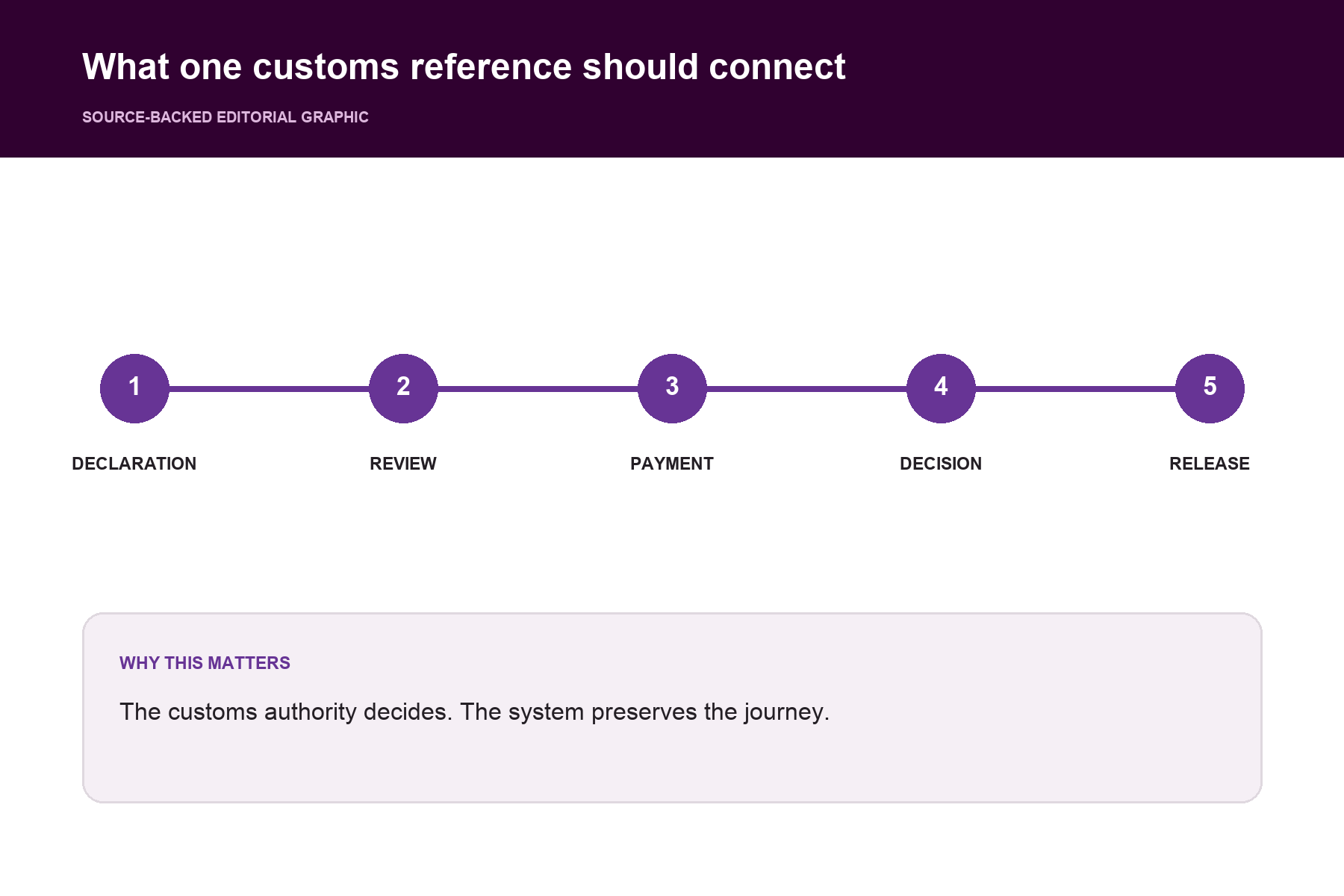
An electronic customs reference should allow a trader and authorised officials to follow one declaration from submission through review, payment and final release without reconstructing the transaction from separate files.
South Sudan introduced e-Customs in Juba and at the Nimule border post in March 2022. The JICA customs capacity report describes the system as a joint development by the National Revenue Authority and Crawford Capital, while Crawford's project page gives the company's account of the implementation.
The system supports the workflow, but the National Revenue Authority remains responsible for customs administration, access rules and official decisions. Keeping that division clear helps traders understand where to direct a legal question and where to report a technical problem.
The reference should remain attached
The journey begins with the trader, goods and transport details. The declaration then moves through classification, valuation or risk review, followed by any payment requirement and the release or inspection decision.
Each action should remain attached to the same reference. If an amount changes, the record should show who approved the change and why. If a declaration is corrected, the original entry should remain in the history rather than disappear.
What a trader should be able to confirm
A trader should be able to identify whether a declaration was received, which stage it has reached and whether further information is required. A payment reference should match the declaration, amount and receiving institution rather than appear as an isolated receipt.
Where cargo is held, the record should identify the responsible authority and the next permitted action without exposing protected enforcement information. Where the system is unavailable, an approved fallback should prevent duplicate submissions when service resumes.
Nimule's importance as a land-border route makes continuity especially important. Connectivity interruptions, high transaction volumes and coordination between border teams can expose weaknesses that are less visible in an office demonstration.
The evidence needed to assess performance
The responsible authority should be able to publish measures such as system availability, electronic declaration volumes, processing times, exceptions, reversals and unresolved reconciliation items. These measures need definitions so that a submitted declaration is not mistaken for a completed release.
Auditors should also be able to select a declaration and follow the full history. That includes the submitted data, official actions, amendments, payment confirmation and release record.
The World Bank's South Sudan digital economy assessment provides wider context on infrastructure, institutions and digital access. Those conditions affect how reliably any border system can operate.
The public record confirms the introduction of e-Customs in Juba and Nimule and identifies Crawford's technology role. The continuing operational test is whether each declaration remains traceable, each public decision is attributable and the authority can demonstrate the system's performance over time.
Sources: JICA customs capacity report, Crawford Capital e-Customs project, World Bank South Sudan digital economy assessment.




Comments