
A major shakeup has hit the U.S. national security establishment after Joseph Kent, Director of the National Counterterrorism Center, announced his resignation while criticizing the ongoing war with Iran.
In a resignation letter addressed to President Donald Trump, Kent said he could not continue serving in his role while supporting a conflict he believes was unnecessary.
Kent wrote that Iran posed no immediate threat to the United States and argued that the war was driven largely by pressure from Israel and pro-Israel lobbying groups in Washington.
“I cannot in good conscience support the ongoing war in Iran,” Kent stated in the letter. “Iran posed no imminent threat to our nation.”
The resignation marks a rare public break within the American intelligence leadership over U.S. foreign policy in the Middle East.
Kent had been serving as Director of the National Counterterrorism Center, a key body responsible for coordinating intelligence operations and counterterrorism strategy across U.S. security agencies.
Claims of Political Pressure Behind the War
In the letter, Kent argued that the United States entered the war due to pressure from Israeli leaders and influential voices within the American media and political establishment.
According to him, these groups pushed a narrative suggesting Iran posed an imminent threat that required immediate military action.
Kent warned that such claims resembled the arguments used to justify earlier wars in the Middle East.
He said similar tactics were used in the lead-up to the Iraq war, which resulted in thousands of American casualties and long-term instability in the region.
“This was a lie,” Kent wrote, referring to the claim that Iran posed an urgent threat requiring military intervention.
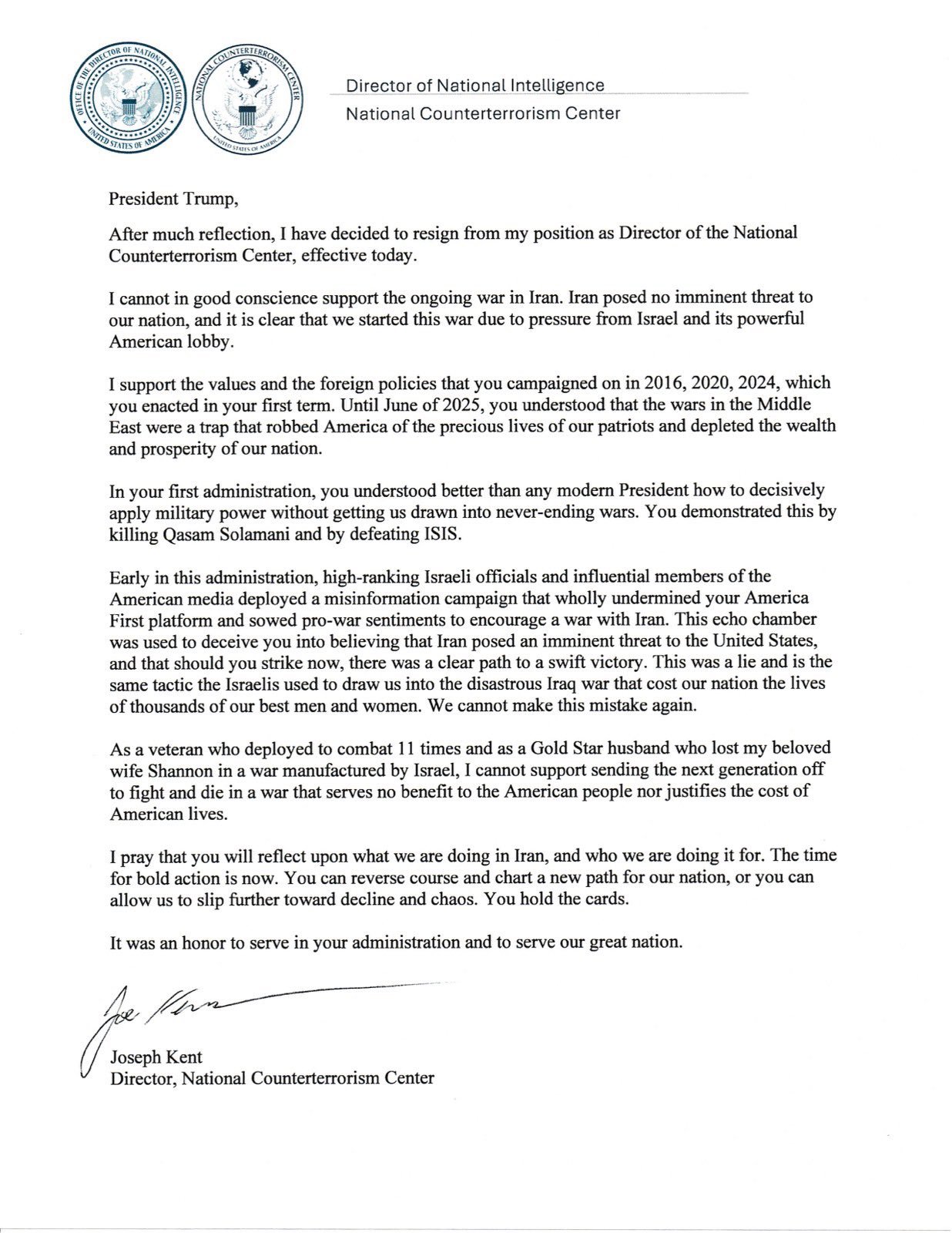
Support for Trump’s Earlier Foreign Policy
Despite criticizing the current war, Kent praised President Trump’s earlier foreign policy approach.
He said Trump previously understood that prolonged wars in the Middle East drained American resources and cost the lives of U.S. soldiers.
Kent referenced the killing of Iranian commander Qasem Soleimani and the defeat of ISIS as examples of decisive military action without becoming trapped in long conflicts.
According to Kent, those strategies demonstrated how military power could be used without dragging the United States into endless wars.
A Veteran’s Personal Perspective
Kent also framed his resignation around his personal experiences as a veteran.
He said he had deployed to combat zones 11 times during his military career.
He also revealed that his wife, Shannon, was killed during a previous conflict he described as a war influenced by Israeli interests.
As a result, he said he could not support sending another generation of Americans to fight in what he described as a war that serves no benefit to the American people.
“As a veteran who deployed to combat 11 times and a Gold Star husband, I cannot support sending the next generation to fight and die in a war that serves no benefit to the American people,” he wrote.
Appeal for Policy Reversal
Kent urged President Trump to reconsider the United States’ current approach toward Iran.
He said the president still had the power to change course and avoid deeper involvement in a conflict that could destabilize the region further.
“You can reverse course and chart a new path for our nation,” Kent wrote.
His resignation letter ends with a message thanking the president and intelligence community for the opportunity to serve.
“It was an honor to serve in your administration and to serve our great nation,” he wrote.
Growing Debate Inside Washington
Kent’s resignation is likely to intensify debate within Washington about the direction of U.S. foreign policy.
The National Counterterrorism Center plays a central role in coordinating intelligence related to global threats.
A resignation at that level over policy disagreements is rare and signals deep divisions within parts of the national security establishment.
Observers say the controversy may also fuel political debate in the United States over the costs and consequences of another Middle East war.
As the conflict continues, Kent’s resignation adds a new voice to the growing discussion about whether the war with Iran was justified and what its long-term consequences may be.