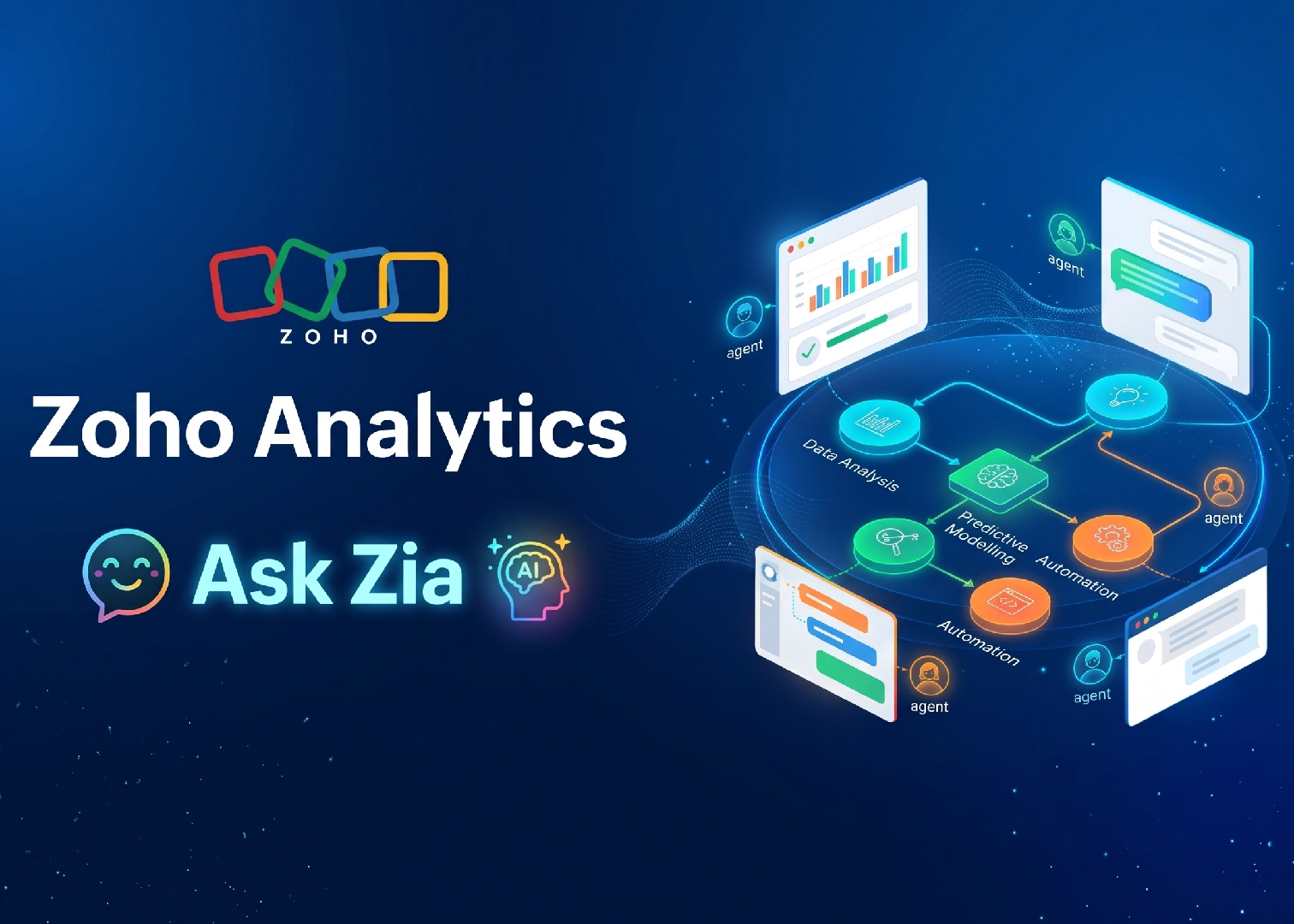
Zoho has enhanced its Analytics platform by embedding a suite of AI agents into Ask Zia, the company’s conversational business‑intelligence assistant, to move users from data collection toward decision‑making and action initiation.
The update uses a multi‑agent architecture that assigns specialised agents to tasks such as data analysis, visualisation, preparation, modelling, coding and execution, rather than relying on a single AI model.
Two new layers – a semantic layer that creates a shared glossary of terms and metrics, and an ontology layer that maps relationships between entities like customers, products and departments – help the agents interpret data consistently.
Veerakumar Natarajan, Zoho’s country head for Kenya, described the upgrade as the start of a “next leap forward in data analytics” and stressed that a solid data foundation is essential for reliable agent performance.
Customers can build custom agents anchored in their own data, business models and knowledge bases, while Ask Zia retains conversation history and agent memory to preserve context across related tasks.
Zoho Analytics supports its own large language model alongside configurable external models, and the platform now opens to third‑party AI assistants through the Model Context Protocol, enabling tools such as Claude to interact with Zoho data.
More than 30 new data connectors have been added to the existing catalogue of over 500, covering Zoho applications and external services including SAP, PayPal, Adobe Commerce, Twilio and Notion.
Zoho states that customer data is not used to train its AI models, but notes that when external services are linked via the Model Context Protocol, query results may be shared with the provider under that provider’s own policies.
Administrators retain control over AI feature activation, data access and agent deployment, with options to require user approval for high‑impact actions such as record modifications or workflow triggers.
Zoho provides AI observability tools that log which agents ran, who used them, what data they accessed and their responses, while sandbox and version‑control features let organisations test agents before publishing.
The company acknowledges that the accuracy of AI‑generated insights still depends on the quality of underlying data, business definitions and configuration, despite the added semantic and ontology layers.



Comments