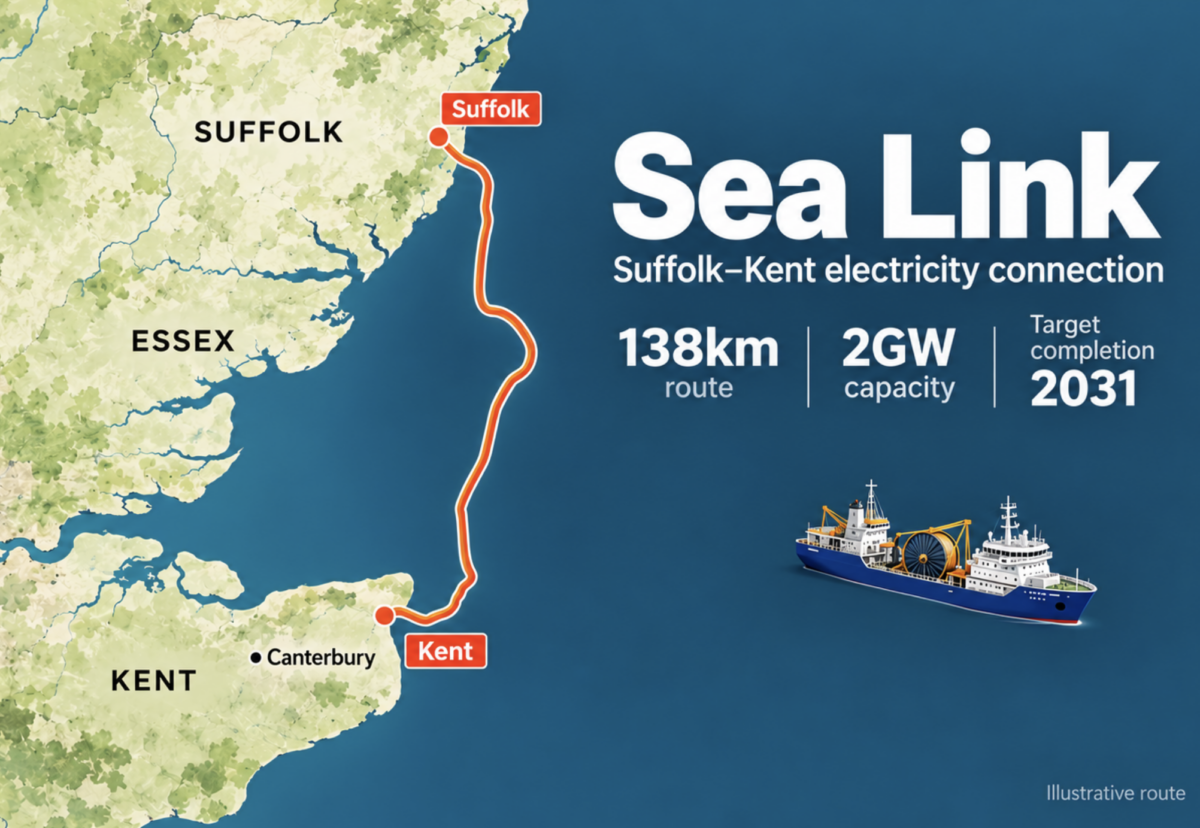
The UK government has issued a Development Consent Order for the Sea Link electricity transmission scheme, clearing the final planning hurdle for the £3 billion project that will connect Kent and Suffolk.
The link will run 138 km, including roughly 122 km of subsea high‑voltage direct current (HVDC) cable crossing the southern North Sea and Thames Estuary, with additional underground and overhead sections on land.
In Kent the cable will land at Pegwell Bay, feed a new converter station near Minster and a new substation adjacent to it; in Suffolk it will reach land north of Aldeburgh, connect to a converter station near Saxmundham and link to the Kiln Lane substation near Friston.
The two converter stations will enable bidirectional electricity flow, converting between HVDC and high‑voltage alternating current (HVAC) as required to balance supply and demand across the network.
National Grid Electricity Transmission has appointed Siemens Energy to deliver the converter stations and associated substation works, while Sumitomo Electric will supply and install the cable system, manufacturing the subsea cables at its new £350 million Port of Nigg facility in Scotland.
Marine contractor Van Oord will partner with Sumitomo Electric on offshore cable laying, providing the specialised installation capability required for the subsea segment.
Construction is slated to begin in early 2027, with the full link expected to be operational by 2031, although National Grid has not yet released a detailed timetable for individual work packages.
National Grid submitted a cost estimate of £3.2 billion (2023/24 prices) to Ofgem; the regulator has proposed funding of about £2.9 billion, with the final decision still pending.
National Grid will provide more than £1 million for community funds in each county, intended to support local facilities, green spaces and skills development as part of the project's social commitment.
The Sea Link scheme forms part of National Grid’s broader Great Grid Upgrade programme, which aims to expand transmission capacity, integrate renewable generation and improve energy security across Britain.




Comments