
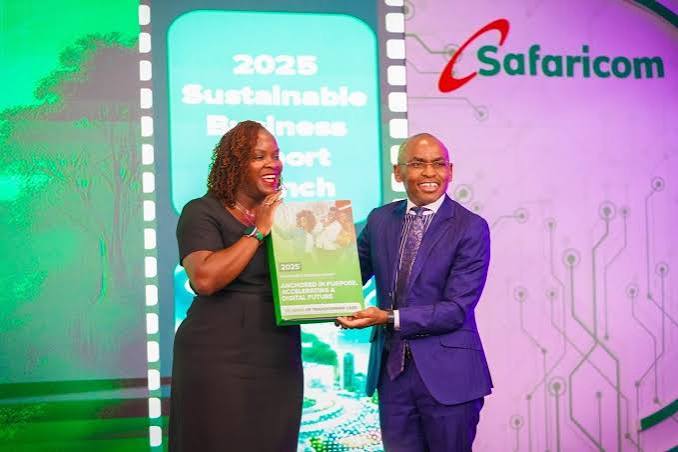
That question deserves particular attention because Karen Basiye is not a peripheral employee watching these programmes from a distance. Safaricom Foundation identifies her as its Director of Sustainable Business and Social Impact, while M-PESA Foundation lists her as Director of Sustainable Business, Social Impact and M-PESA Foundation. An academic profile published by Lund University's International Institute for Industrial Environmental Economics goes even further in describing her role, stating that she leads the Safaricom and M-PESA Foundations' work in deciding which projects receive funding.
That places Basiye close to one of the most powerful corporate philanthropy operations in Kenya. Schools are constructed, hospitals equipped, water projects financed and communities transformed with investments running into tens and sometimes hundreds of millions of shillings. These are laudable interventions where communities genuinely need them. But precisely because the money carries enormous social and political value, the people controlling its distribution should be subjected to equally enormous scrutiny.
The question now confronting Basiye is not whether Safaricom Foundation has done good work. Its footprint around Kenya is extensive and documented. The harder question is whether the system used to determine where that good work happens is sufficiently transparent to demonstrate that political access, powerful friends and proximity to government have absolutely nothing to do with it.
In July 2023, Safaricom Foundation's investment in two schools in Tongaren provided an example of why the political optics cannot simply be brushed aside. The Foundation committed KSh35 million to Naitiri Primary School and Naitiri RC Primary School, and National Assembly Speaker Moses Wetang'ula appeared alongside Basiye during the launch. Parliament's own publication documented Wetang'ula and Basiye together at the project event.
There is nothing improper, by itself, about the Speaker appearing at a development project. Neither does his presence establish that he influenced the allocation. But when a corporate foundation capable of injecting tens of millions of shillings into individual communities repeatedly works in an environment populated by influential politicians, merely saying that projects are selected on merit is not enough. The Foundation should be prepared to show the paperwork that demonstrates it.
The sums involved make that transparency imperative. In June 2025, M-PESA Foundation announced another KSh151 million for education projects across Bungoma, Homa Bay and Baringo. KSh55 million was allocated for new facilities at Toroso SA Primary School in Bungoma, another KSh55 million went to Ligongo Primary School in Homa Bay, while KSh41 million was committed to facilities in Baringo. Safaricom said the projects formed part of its Citizens of the Future programme and maintained that its school investments focused on the country's "neediest cases."
That claim provides the perfect standard against which Basiye's leadership should be tested. If need determines where the money goes, then Safaricom should publish the needs assessments. Kenyans should be able to see why one school qualified for KSh55 million while another equally dilapidated school did not. They should be able to establish whether poverty levels, classroom congestion, water access, health indicators and existing government infrastructure were scored before funding decisions were made.
More importantly, Safaricom should disclose whether politicians nominate, recommend or lobby for projects and, where they do, what safeguards prevent political influence from becoming an unofficial ticket to corporate philanthropy.
This matters because Kenya's political culture turns almost every development project into political capital. A politician standing beside a newly constructed classroom can tell constituents that development has arrived under his or her watch even when taxpayers did not finance the project. A KSh50 million corporate intervention can consequently acquire electoral value far beyond the monetary value of the buildings themselves.
Safaricom and Basiye should therefore understand why appearances matter. Corporate charity cannot be allowed to become an invisible extension of political patronage, and the best way of demonstrating that this is not happening is through radical transparency rather than carefully worded public-relations statements.
The evidence currently available does not, however, support the sweeping conclusion that Safaricom's charitable investments simply bypass opposition territory. That distinction is important. M-PESA Foundation's own documented programmes include significant investments in politically diverse parts of Kenya, and Basiye herself has described projects spanning counties including Trans Nzoia, Marsabit, Makueni, Bungoma and Kisumu.
Indeed, the KSh151 million programme itself included a KSh55 million investment in Homa Bay, a county long associated with opposition politics. That fact makes it impossible, on the evidence presently available, to responsibly declare that Foundation money is exclusively reserved for constituencies represented by politicians friendly to the national government.
But that does not make the political-favouritism question disappear. It simply changes the question from accusation to audit.
Safaricom should open the books on the geographical distribution of its charitable projects. Not selective press releases. Not photographs of ribbon-cutting ceremonies. Not carefully produced impact videos. The actual allocation data.
For every project approved under Basiye's leadership, Safaricom should disclose the constituency, county, amount committed, date of application, date of approval, beneficiary institution, person or organisation that proposed the project, selection criteria and final approving authority. Where an MP, governor, Cabinet Secretary, Principal Secretary or other political office-holder made representations supporting a project, that information should also be disclosed.
Once that information is available, the political question becomes remarkably easy to answer. Journalists and the public could calculate how much money went into constituencies represented by government-aligned MPs and how much reached constituencies controlled by opposition parties. They could compare the number and monetary value of projects, then adjust those figures against population, poverty and infrastructure indicators.
If the numbers show no politically meaningful disparity, Basiye and Safaricom will have produced evidence far more convincing than any corporate statement could ever be.
If the numbers reveal that politically connected constituencies repeatedly secured bigger or more frequent projects without corresponding indicators of greater need, then the Foundation would face much harder questions about its governance and project-selection process.
That is why transparency matters more than political rhetoric.
Basiye's own professional profile makes the demand particularly relevant. Safaricom describes her background as encompassing governance, sustainability reporting, social policy, environmental compliance and corporate philanthropy. She has spent years building a professional reputation around precisely the principles that should make disclosure of funding criteria an uncomplicated proposition.
There is also an important distinction between doing good and governing good works properly. A classroom can unquestionably benefit children while questions remain about why that particular school was chosen. A hospital wing can save lives while the process through which it secured funding still deserves scrutiny. Corporate philanthropy does not become immune from accountability merely because its final product benefits vulnerable people.
The larger Safaricom's philanthropic footprint becomes, the stronger that accountability must become. Basiye herself has described M-PESA Foundation as pursuing capital-intensive interventions across health, education, environmental conservation and economic empowerment. The Foundation says its work is intended to tackle poverty and marginalisation, while Safaricom Foundation presents education, health and economic empowerment as central pillars of its operations.
Those objectives demand political neutrality. A child in an opposition-held constituency does not become less deserving of a classroom because of the party represented by the local MP. A mother requiring maternity services should never have to wonder whether her county's relationship with State House affects access to corporate-funded healthcare. A village without clean water should not require a politically connected intermediary to become visible to a foundation controlling millions of shillings.
Nobody should have to rely on political connections to get onto Safaricom's philanthropic radar.
That is the standard Basiye and Safaricom should be willing to demonstrate they meet.
The company has the records. It knows where every shilling was allocated. It knows who approached the Foundation. It knows which communities competed for funding, which succeeded and which were rejected. It knows which politicians attended meetings or launches and which projects originated from community requests rather than political offices.
Publishing that information would do more than answer critics. It would establish a benchmark for corporate philanthropy in Kenya and protect Safaricom Foundation itself from politicians attempting to appropriate charitable projects as personal development achievements.
Until then, the photographs, multimillion-shilling announcements and appearances alongside powerful politicians will continue attracting questions.
Karen Basiye is entitled to be judged on evidence rather than political insinuation. But occupying a position with influence over such substantial social investment also means accepting scrutiny over how that influence is exercised. The answer is therefore not silence and certainly not another glossy campaign about lives transformed.
The answer is the data.
Let Kenyans see where the Foundation's millions have gone, how beneficiaries were selected and whether political connections played any role. Once those records are public, the country will not need anybody to tell it whether Safaricom's charity follows genuine need or political access.
The numbers will speak for themselves.


Comments