An organisation’s digital footprint is larger than its website. It includes search results, directory listings, executive profiles, old campaign pages, customer reviews, news coverage, social accounts and documents uploaded years ago. Each item may be accurate on its own while the combined picture is confusing or out of date.
A complete reputation programme takes time, but a focused working-day audit can identify the most important gaps. The purpose is not to hunt for anything unflattering and demand its removal. It is to understand what a reasonable customer, journalist, job candidate or partner will find—and whether the organisation can support, correct or improve that picture.
Hour one: define the identity being checked
Write down the organisation’s exact legal name, trading names, common misspellings, website domains, senior leaders, flagship products and main locations. Include former names that still appear in public records. This becomes the query list.
Start the review in a signed-out or private browser window and record the date, query and first two result pages. A formal online reputation assessment goes deeper, but even a simple spreadsheet will expose name confusion, duplicate profiles and old pages that carry too much weight.
Hours two and three: test search and owned channels
Search each name with terms such as reviews, contact, leadership, jobs, complaints and the organisation’s main service. Do not score a result as “bad” merely because it is critical. Record whether it is accurate, current, attributable and relevant.
Then inspect the assets the organisation controls. Does the company website explain who owns the organisation, what it does, where it operates and how to reach it? Are leadership biographies current? Do contact details agree across pages? Are privacy notices and terms accessible?
Google’s people-first content guidance asks whether pages provide original information, clear sourcing, useful depth and trustworthy authorship. Apply those questions to every important owned page. A polished design cannot compensate for missing facts.
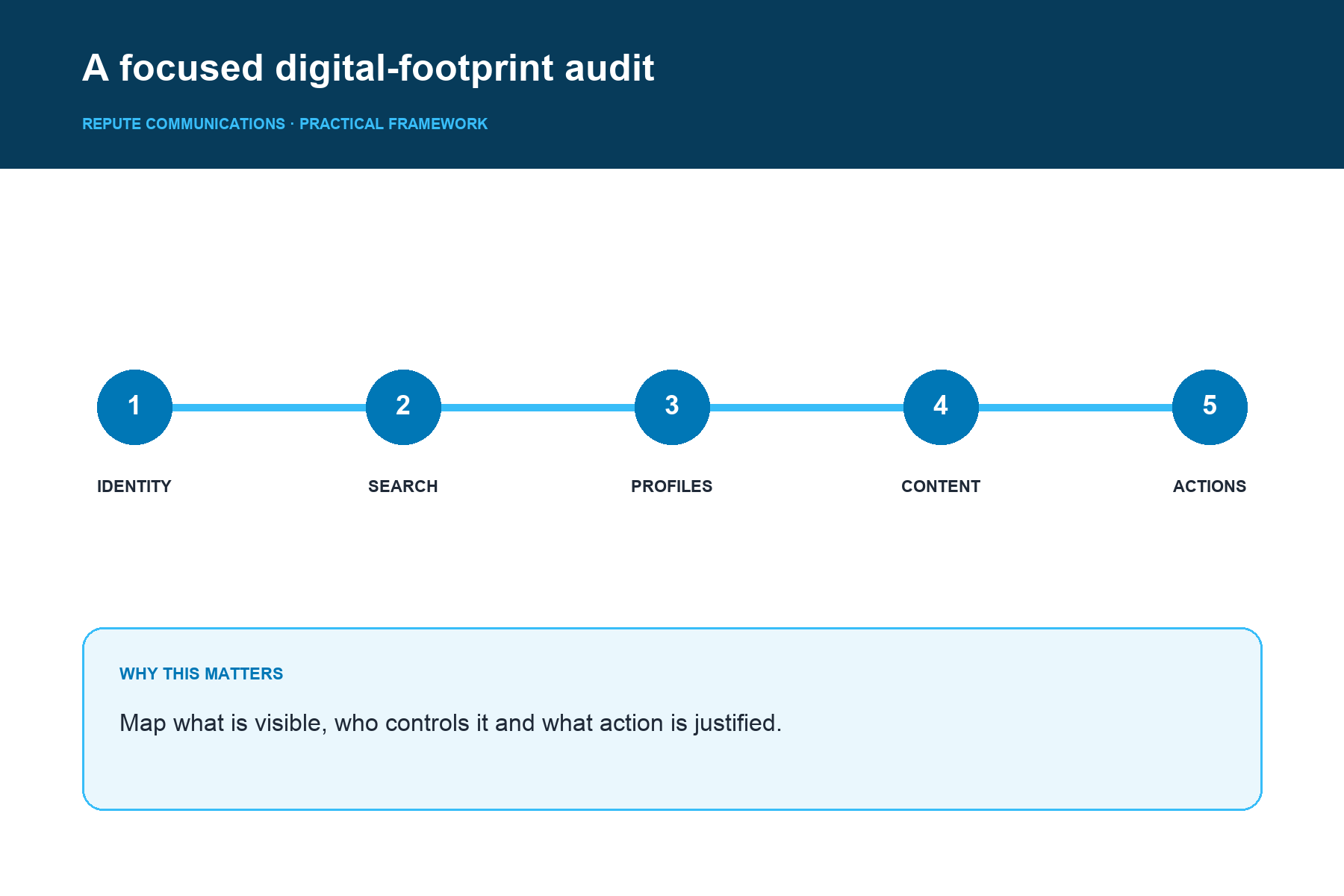
Hour four: reconcile profiles and listings
Check major business listings, professional networks and every official social account. Record the account owner, recovery contact, last update and whether the profile points to the correct website. An abandoned account can be mistaken for an official source long after staff have lost access.
This is where brand strategy and social media management become practical controls. Names, descriptions and imagery should be recognisably connected, while each platform still serves a clear audience.
The audit is not a popularity contest. It is an evidence check: what is visible, who controls it and what action is justified.
Hour five: map reviews and public feedback
List the platforms where customers actually leave feedback. Check whether the organisation responds, whether repeated complaints point to an operational problem and whether suspicious praise or attacks need platform review. Never manufacture balance with fake reviews.
Google’s Maps contribution policy prohibits fake engagement, paid or incentivised reviews that do not represent a genuine experience, and content posted from multiple accounts to manipulate ratings. Ethical online reputation management focuses on real service improvement, professional responses and policy-based reports where a review genuinely breaks the rules.
Hours six and seven: identify the content and monitoring gaps
Compare what audiences need with what the organisation has published. There may be no authoritative leadership page, no clear explanation of a complicated service, no current photograph library or no response to a recurring factual error. Content development should fill those gaps with useful records, not keyword-heavy filler.
Check basic digital marketing and SEO controls: descriptive titles, one canonical version of important pages, working links, current sitemaps and meaningful image descriptions. Google’s spam policies warn against link schemes, keyword stuffing and scaled low-value content. Those shortcuts can create a second reputation problem while trying to solve the first.
Set up media monitoring for the names and issues that matter, but avoid collecting personal data simply because a tool makes it possible. Monitoring should have a purpose, a limited audience and a review process.
Hour eight: rank actions by evidence and control
Create four queues: correct now, update this week, investigate, and monitor. A wrong phone number on an owned profile may be fixed immediately. An inaccurate article needs a documented correction request. A lawful critical opinion may require an operational response, not a takedown demand. A missing profile may call for a new authoritative page.
Assign an owner and deadline to each action. Save screenshots and URLs with the audit date so the next review can measure change. Repute Communications combines reputation management services, content, search and monitoring for organisations that need a fuller programme. Its team can be reached through a confidential consultation request.
Sources: Google people-first content guidance, Google Maps contribution policy, Google Search spam policies, Repute Communications online reputation management.



Comments