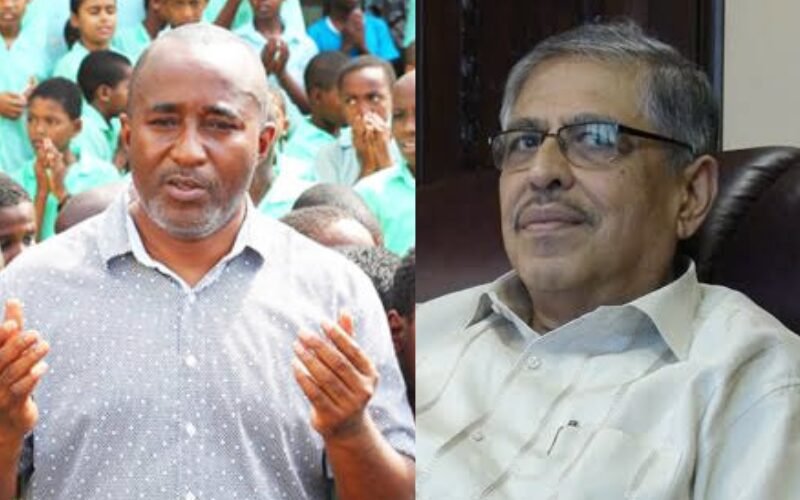
Court Testimony Exposes Alleged Smear Network as Finger Points at Mombasa Tycoon Mohamed Jaffer
A defamation case unfolding in a Mombasa court has taken a dramatic turn after court testimony linked a coordinated smear campaign to business interests associated with tycoon Mohamed Jaffer, raising serious questions about how corporate power may be weaponised to destroy reputations.
At the centre of the case is a viral letter that accused businessman Abubakar “Abu” Joho and his family of drug trafficking, fraud, and illegal dealings at the Port of Mombasa. The document circulated widely online at the height of national protests, amplifying its impact and damage.
What now separates this case from routine online defamation is what was revealed under oath.
A key witness told the court that the smear operation was not spontaneous, not anonymous outrage, and not organic activism. According to the testimony, it was planned, directed, and executed using intermediaries, with instructions flowing from individuals connected to Jaffer’s business orbit.
The witness, an employee linked to the operation, admitted in court to being used as part of the campaign, describing how defamatory material was prepared, shared, and pushed online with the clear intention of damaging Abu Joho’s name and credibility.
The confession stripped away the convenient fiction that the attacks were random social media chatter.
This was not noise.
It was orchestration.
A Business Rivalry Turned Character Assassination
In court, Abu Joho directly named Mohamed Jaffer as the man he believes stood behind the smear effort, telling the magistrate that the attacks were driven by a long running business rivalry.
He described the campaign as economic warfare by other means, where reputation becomes the battlefield and lies become weapons.
According to the testimony, the attacks went far beyond business criticism. They dragged in Joho’s family, his elderly mother, and even fabricated claims about his birth and personal history.
These were not allegations meant to inform the public.
They were meant to humiliate, intimidate, and break.
The Employee Confession That Changed Everything
The most damaging moment for Jaffer came when the court heard that an individual involved in spreading the defamatory content was acting under direction, not personal initiative.
The witness described how the material was framed, how it was timed, and how it was circulated to achieve maximum damage. The testimony pointed to a chain of instruction, undermining claims that Jaffer was merely an innocent bystander to online excesses.
For legal observers, that confession shifted the case from speculation to structure.
Smear campaigns do not require signatures.
They require money, coordination, and silence.
AI Excuses and a Failing Defence
The accused publisher attempted to distance herself from the content by claiming it was generated using artificial intelligence and lacked forensic fingerprints tying it directly to her.
But the confession from within the alleged operation weakened that defence.
Courts do not rely on excuses.
They rely on testimony.
And testimony placed the smear campaign within a deliberate ecosystem, not an accidental digital mishap.
Power, Ports, and Untouchable Myths
Mohamed Jaffer is no ordinary businessman. His companies sit at the heart of critical port infrastructure and logistics operations. For years, critics have whispered about the imbalance of power in Mombasa’s commercial space.
This case dragged those whispers into open court.
It raised a chilling question.
What happens when business disputes leave boardrooms and enter people’s lives?
The Human Cost of Paid Lies
Abu Joho told the court that the campaign left deep scars on his family, with children questioning their father and relatives forced to defend themselves against accusations they did not understand.
Reputations take decades to build.
They can be burned in hours.
The court heard that the objective was not truth, accountability, or justice.
It was destruction.
What Mohamed Jaffer Has Not Explained
Despite the weight of the testimony, Mohamed Jaffer has not appeared in court to personally answer the allegations, nor has he offered a public explanation addressing the confession that placed his business interests at the centre of the operation.
Silence, in the face of sworn testimony, speaks loudly.
A Line Has Been Crossed
This case is no longer about one defamatory letter.
It is about whether powerful businessmen can outsource dirty work, hide behind employees, and use money to erase competitors from public life.
If courts fail to draw a hard line here, the precedent will be dangerous.
Today it is Abu Joho.
Tomorrow it could be anyone who stands in the way.
What the Case Now Represents
This trial has become a test of whether Kenya’s justice system can confront elite sponsored misinformation, not just online trolls.
It asks whether truth still matters when influence is involved.
And it forces the country to confront an uncomfortable reality.
Smear campaigns do not run on rumours.
They run on funding.
And funding always has a source.